Navigating Your Mind: Understanding Cognitive Distortions
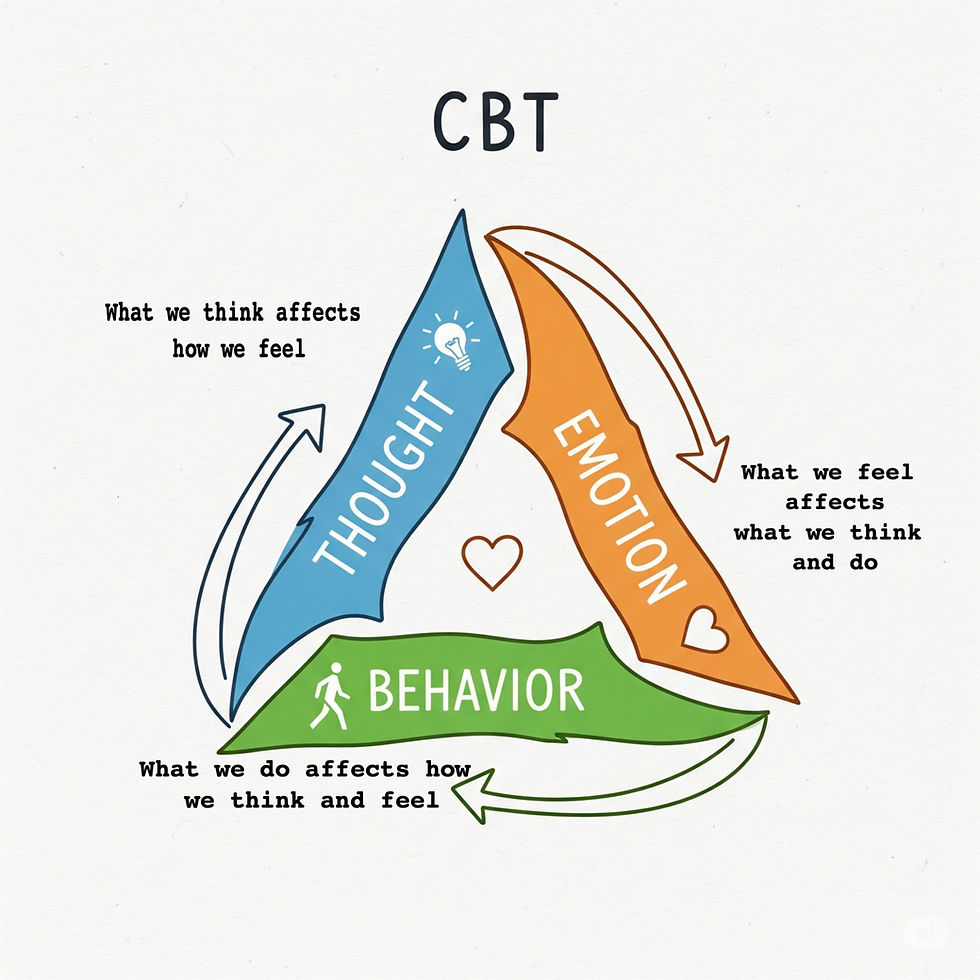
One of the cornerstones of Cognitive Behavioral Therapy (CBT) is learning to identify and challenge irrational beliefs—those automatic, often subconscious thoughts that distort reality and fuel emotional distress. These thoughts can seem convincing in the moment, but left unchecked, they reinforce negative patterns of behavior and mood.
By bringing these beliefs into conscious awareness, we begin to take away their power—making space for more balanced thinking, healthier emotional responses, and more intentional action.
The Power of Automatic Thoughts
Many of the distorted thoughts we experience occur automatically—so quickly and subtly that we often don’t notice them. These automatic thoughts are deeply influenced by underlying core beliefs and past experiences. When left unchallenged, they can create a self-fulfilling cycle of anxiety, depression, or low self-worth.
Psychiatrist Aaron Beck, one of the founders of CBT, identified 11 common cognitive distortions—patterns of thinking that are irrational, unhelpful, and yet incredibly common. Recognizing these patterns is the first step toward change.

All or Nothing Thinking
This distortion is also known as "black-and-white thinking." With this mindset, you see things in extreme, opposing categories. If your performance falls short of perfect, you view yourself as a total failure. There's no middle ground, no room for nuance or a gray area. This can be an exhausting and rigid way to view your life.
“If I’m not the best, I’m worthless.”
Over-Generalisation
With this distortion, you take a single negative event and blow it up into a continuous, never-ending pattern of defeat. For example, if you have a bad date, you might conclude, "I'll always be alone because I'm terrible at dating." You create a broad, negative conclusion based on a single piece of evidence.
“I didn’t get the job—nothing ever works out for me.”
Mental Filter

This involves picking out a single negative detail and dwelling on it exclusively, which darkens your entire perception of reality. The "mental filter" acts like a drop of ink in a cup of water, tainting the whole thing. For instance, you might receive several positive comments on a work presentation but focus only on one piece of constructive criticism, making you believe the presentation was a failure.
“I made one mistake during the presentation, so it was a disaster.”
Disqualifying Positive
In this distortion, you reject positive experiences by telling yourself they "don't count" for some reason. If someone compliments your work, you might think, "They're just being nice" or "I just got lucky." This allows you to maintain a negative belief about yourself even when it is contradicted by everyday experiences.
“They only complimented me because they felt sorry for me.”
Jumping to Conclusions - Mind Reading
This happens when you arbitrarily assume you know what another person is thinking, and you conclude they are reacting negatively to you without any real evidence. For example, a friend might not respond to your text right away, and you immediately assume they're angry with you.
“She didn’t text back because she’s mad at me.”
Jumping to Conclusions - The Fortune Teller Error
With this distortion, you predict that things will turn out badly and then treat your prediction as a fact. You convince yourself that a poor outcome is inevitable, which often becomes a self-fulfilling prophecy. For example, before an important meeting, you think, "I'm going to mess this up," which causes you to feel so anxious that you actually perform poorly.
“I just know I’ll mess this up.”
Magnification / Catastrophising or Minimisation

This distortion is also known as the "binocular trick" because you either magnify the importance of things or shrink them until they appear tiny. You might catastrophize a small mistake at work, believing it will lead to you being fired. Conversely, you might minimize your own achievements, seeing them as unimportant.
“If I make one mistake, it’ll ruin everything.”
“My success wasn’t a big deal—it was just luck.”
Emotional Reasoning
This involves assuming that your negative emotions are a reflection of reality: "I feel it, therefore it must be true." For example, if you feel anxious on a flight, you might believe this feeling means the plane is unsafe. This can lead you to make decisions based on your feelings rather than objective facts.
“I feel anxious, so something bad must be happening.”
"Should" Statements
You try to motivate yourself or judge others with rigid "shoulds" and "shouldn'ts". The emotional consequence of these statements is guilt when they are directed at yourself and anger or frustration when they are directed at others.
"I should exercise every day."
"I must never make a mistake."
Labelling and Mislabelling
This is an extreme form of over generalisation. Instead of describing a specific error, you attach a negative label to yourself or to someone else. This kind of language is highly emotional and doesn't accurately describe the situation, only your intense feelings about it.
“I’m such an idiot.”
“He’s useless.”
Personalisation
With this distortion, you see yourself as the cause of some negative external event, even when you were not primarily responsible. For instance, if a colleague is in a bad mood, you might immediately assume you did something to upset them. You blame yourself for events that are out of your control.
“It’s my fault my friend is upset.”
Why These Distortions Matter
Cognitive distortions aren’t just faulty logic—they are often deeply tied to emotional distress. By identifying them, we interrupt the cycle that fuels low mood, anxiety, and reactivity. When we challenge these distorted thoughts with curiosity and evidence, we begin to make space for more grounded, compassionate thinking.
Taking the Next Step
Start to notice when one of these distortions shows up in your own thinking. You don’t have to “fix” it right away—just name it. Awareness is the first step toward transformation.
References & Further Reading
Beck, J. S. (2011). Cognitive Behavior Therapy: Basics and Beyond (2nd ed.). New York: The Guilford Press.
Burns, D. D. (1980). Feeling Good: The New Mood Therapy. New York: William Morrow.
Leahy, R. L. (2003). Cognitive Therapy Techniques: A Practitioner’s Guide. New York: Guilford Press.
Ellis, A. (1962). Reason and Emotion in Psychotherapy.
Beck Institute for Cognitive Behavior Therapy.


Comments